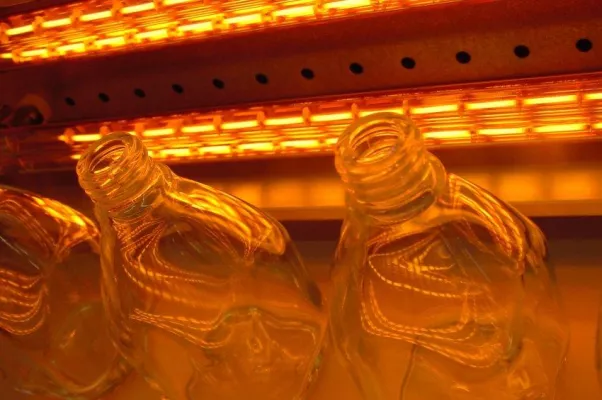
On the tempering line, edge heating isn’t a nice-to-have—it’s the difference between making yield and watching glass shatter at the quench. When the edge profile isn’t even, thermal stress builds right at the boundary. The press bends, re-bends, and still the glass gets rejected. We designed these edge heating lamps to break that loop. What matters under the hood They run on short-wave quartz infrared, delivering fast, localized heat with tight control over the thermal band. Power is matched to the line—typically 2–4 kW per lamp—so you can move from low-E coatings to thicker float without slowing the conveyor. Filament geometry and reflector layout are tuned to create a uniform thermal field across the edge. That uniformity is what keeps the sharp gradients from driving micro-cracks before the furnace even does its work. You get quick ramp-up, repeatable output, and stable emissivity behavior shift after shift. Why this works in tempering The edge is always the weak link. These lamps pre-heat the perimeter so the glass hits the furnace with a consistent edge temperature. That cuts the shock at the quench and improves optical flatness. The payoff is fewer roll-wave defects, fewer edge chips, and a higher first-pass yield. Energy use drops because the heat goes where it’s needed—right on the edge—instead of warming the whole sheet. Field-level details Compatibility is straightforward. We supply drop-in replacement kits for common glass machinery brands, with pre-wired connectors and mounting hardware to keep installation time down. One practical note: keep the quartz envelope clean. Dust and coating residues on the lamp surface scatter the infrared and can drift the temperature profile. A scheduled wipe and a simple air purge are small steps that keep the heating repeatable, day in and day out.